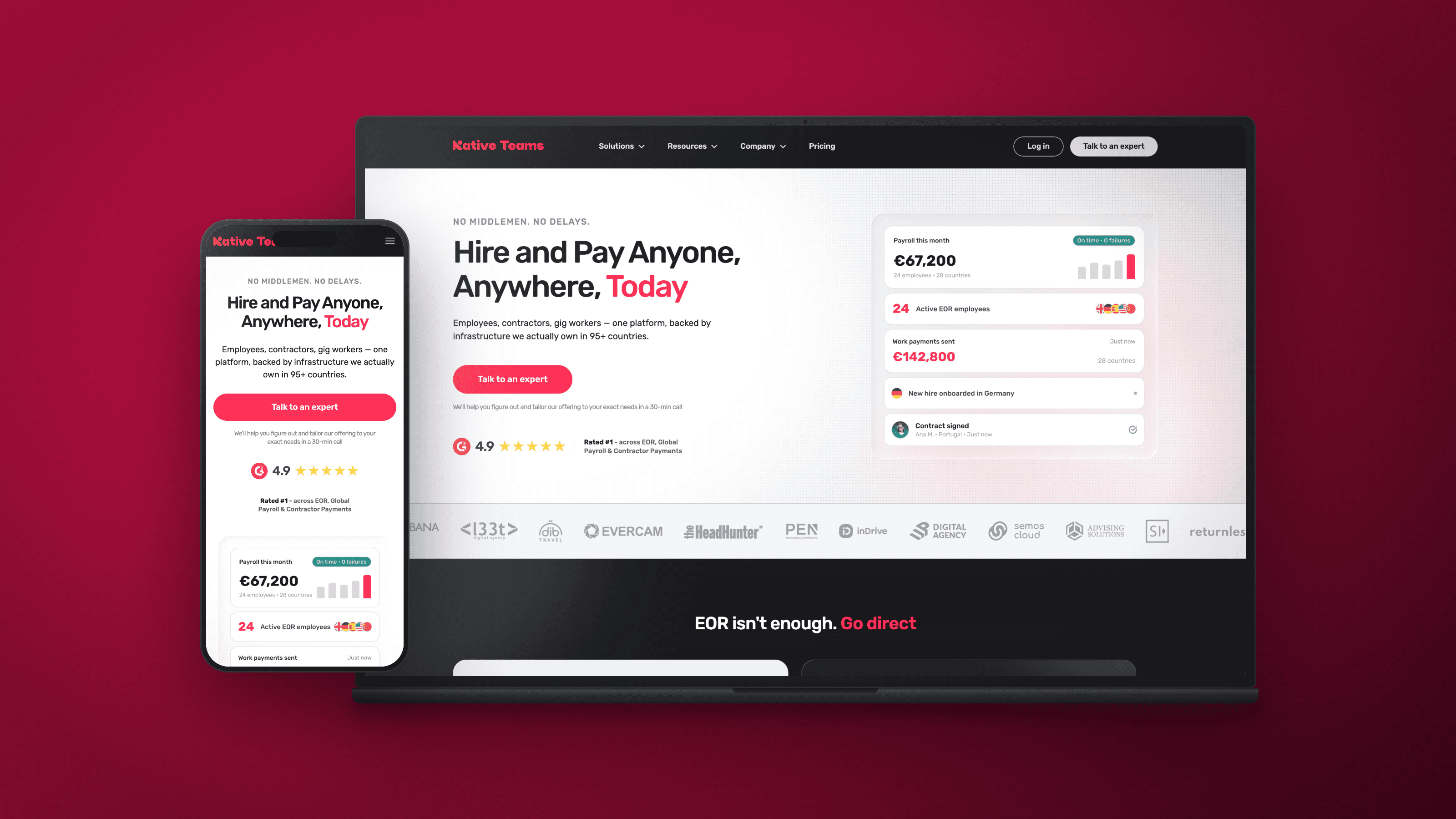
I joined Native Teams when there was no revenue and no marketing function. I left four years later with a company operating in 95 countries, the overwhelming majority of leads coming inbound, and a run rate that made it one of the stronger mid-market EOR platforms in Europe. This is what happened in between.
Joining early, with no playbook and no budget history
Native Teams had a genuinely interesting product: EOR services offered directly to freelancers and remote workers, with no company required to stand behind them. A contractor could get properly employed, handle their taxes, and access benefits without relocating or waiting on a client to set up a local entity. In a market where PayPal and Payoneer were the default, that was a real differentiator.
When I joined, the challenge wasn't the product. It was that almost nobody knew the category existed. There was no paid media history to build on, no SEO authority, no established demand to capture.
Everything had to be created from zero, which meant the first job was as much market education as it was acquisition.
I started with PPC because it was the fastest way to find out what messaging worked, which buyer segments had intent, and what the actual conversion funnel looked like before investing heavily in longer-term channels.
Setting up PPC from scratch and learning what the market actually responded to
The first paid campaigns were B2C, targeting freelancers and remote workers across Europe. Campaign structure was built around buyer intent rather than keyword volume: the people searching for how to get paid compliantly as a contractor in Germany had completely different needs and conversion behaviour than someone looking for general payroll software.
A lot of the early work was iterative in a way that doesn't get captured in a final number. Testing headlines, killing ad groups that were spending without converting, figuring out which compliance pain points resonated in which markets.
The acquisition efficiency we eventually achieved didn't exist at the start. It was the output of months of refinement on top of a measurement framework built to track not just leads but the full path to revenue.
I treated the first year of PPC as paid research as much as paid acquisition. Every campaign was telling us something about what the market cared about.
Tracking was non-negotiable from day one.
Full-funnel measurement connecting spend to pipeline to revenue was the infrastructure everything else was built on. Without it, the B2B transition that came later would have been much harder to diagnose and fix.
Seeing the B2B opportunity before we were set up to capture it
As the B2C base grew, a pattern became hard to ignore: the companies on the other side of these freelancer relationships had the same problem in reverse. They needed to hire internationally without setting up local entities. The category was already being validated at scale by well-funded competitors raising hundreds of millions. The B2B market was real and we had a price point 4x below the enterprise-tier players competing for it.
I led the B2C marketing push while we started testing B2B in parallel.
The instinct to move was right. The first execution wasn't.
What didn't work and why
The same campaign logic that worked well for B2C, fast intent signals, short decision cycles, direct response creative, produced very little when pointed at B2B buyers. We spent without generating proportionate pipeline for a period. The root cause was a mismatch in assumptions: B2B buyers in EOR operate on much longer timelines, involve multiple stakeholders, and need significantly more touchpoints before a sales conversation makes sense. Once I rebuilt the model around that reality, tightened the SQL definition with sales, extended nurture sequences, and fixed attribution to track the full path to closed-won, the results changed quickly.
What changed when it worked
B2B LTV was significantly higher than B2C. Once the acquisition model accounted for the longer sales cycle properly, spend-to-LTV ROI exceeded 500% at peak. The B2B transition went from the most difficult period of my time there to the clearest inflection point in the company's revenue growth.
From running PPC to leading the full marketing strategy
My scope expanded as the company scaled. What started as owning PPC grew into leading B2C acquisition across all channels, then leading the B2B paid strategy, and eventually owning the entire marketing function as Head of Marketing Strategy. Each transition came with a different set of problems to solve.
- PPC setup and B2C acquisition — Built paid search from zero. Campaign architecture, measurement framework, tracking from click to closed-won. Managed B2C campaigns across 30+ European markets. Established the acquisition model that the rest of the marketing function would be built around.
- Leading B2C marketing across all channels — Ownership expanded beyond PPC to the full B2C channel mix: SEO, email, events, webinars and offline. Managing channel leads and aligning the strategy across a growing team while the B2C product and market continued to develop.
- Transitioning to B2B and leading the highest-volume markets — Moved into leading B2B marketing with a focus on Eastern markets — some of the most populated and competitive in the world. The task was building an acquisition model that could outperform Western market benchmarks on both cost and volume. CPSQL and cost per won deal came down consistently across multiple quarters while quarterly growth stayed above 30%.
- Leading the full function as the company scaled toward €40M ARR — As the company grew and the marketing organisation expanded to over 50 people, my focus shifted from leading PPC teams to owning the broader strategy. This meant running offline marketing, events, and ideation, supporting the PPC function at a strategic level rather than operationally, and building out an ABM programme as we began targeting enterprise clients. I built and led my own teams across these areas while the paid acquisition function continued to scale independently.
Growing 30% every quarter while acquisition costs kept falling
The number I'm most proud of isn't the final ARR. It's the direction of the acquisition metrics over time.
CPSQL came down. Cost per won deal came down. The quarterly growth rate held consistently above 30% throughout. Those three things happening simultaneously in a capital-constrained environment, competing against companies spending significantly more, is the result that took the most work to achieve.
- Cost per SQL over time - Falling. Achieved through buyer-type segmentation and intent-first targeting. This number fell consistently as the model matured — not the other way around.
- Cost per Won Deal over time - Falling. Depending on price tier, 3 to 6 months of retention covered the full acquisition cost. Everything after that was margin — and retention in EOR tends to be long.
- Growth QoQ, sustained - 30%+. Every quarter across four years, through the B2C phase, through the B2B transition, through expansion into 95 countries. Growth held while costs were falling.
- Dominant lead source - Inbound. PPC and organic combined. The result of four years of consistent investment in both channels. It compounds slowly and then all at once.
Two numbers matter more than the rest.
- Watched the marketing organisation grow from two people to over fifty. I was there for all of it — from the early days of building the first campaigns to leading my own teams within a much larger function. Across that time I held three distinct roles, each with its own team and scope, finishing as Head of Marketing Strategy.
- Zero revenue to €40M ARR across 95 countries. Marketing was responsible for the vast majority of pipeline throughout. By the end, the overwhelming majority of leads came inbound and the company was one of the stronger mid-market EOR options in Europe on price and coverage.
What four years in a fast-moving category actually teaches you
The most valuable thing I took from Native Teams wasn't any single campaign result. It was understanding what marketing infrastructure looks like when it's built to scale rather than to perform in the short term. Setting up tracking correctly before it feels urgent. Defining what a qualified lead actually means before spending on acquisition. Building organic programmes before you need them to carry load.
The B2B transition was the hardest period. We got the strategy right and the initial execution wrong, which cost time and budget. What made it recoverable was having the measurement in place to see exactly where the model was broken rather than guessing. That experience is probably the most directly applicable thing I carry into any new engagement.
Most marketing problems are measurement problems first. Fix what you're tracking and the decisions that follow usually become obvious.