B2B SaaS attribution before Series A, and what to ignore
B2B SaaS attribution before Series A: UTM rules, CRM source fields at form fill and opportunity, a self-reported field, and what to skip until later.

LukaGrowth13 min read
Key takeaways
4 things to take awayClick-based B2B SaaS attribution misses what no tracker sees: a Slack share, a podcast mention, the rest of the buying committee.
Safari's ITP deletes script-set cookies after 7 days without interaction, or after 24 hours if a tracker's decorated link brought the visitor.
GA4 now offers data-driven attribution and two last-click models. First click, linear, time decay and position-based were removed in November 2023.
You need UTM rules, CRM source fields at form fill and opportunity, a self-reported field and one reconciliation a month.
Safari deletes the cookies your site's own scripts create after seven days without a visit. A B2B deal with several people on the buying side can take months to close, so the click that started it is often gone long before anyone signs.
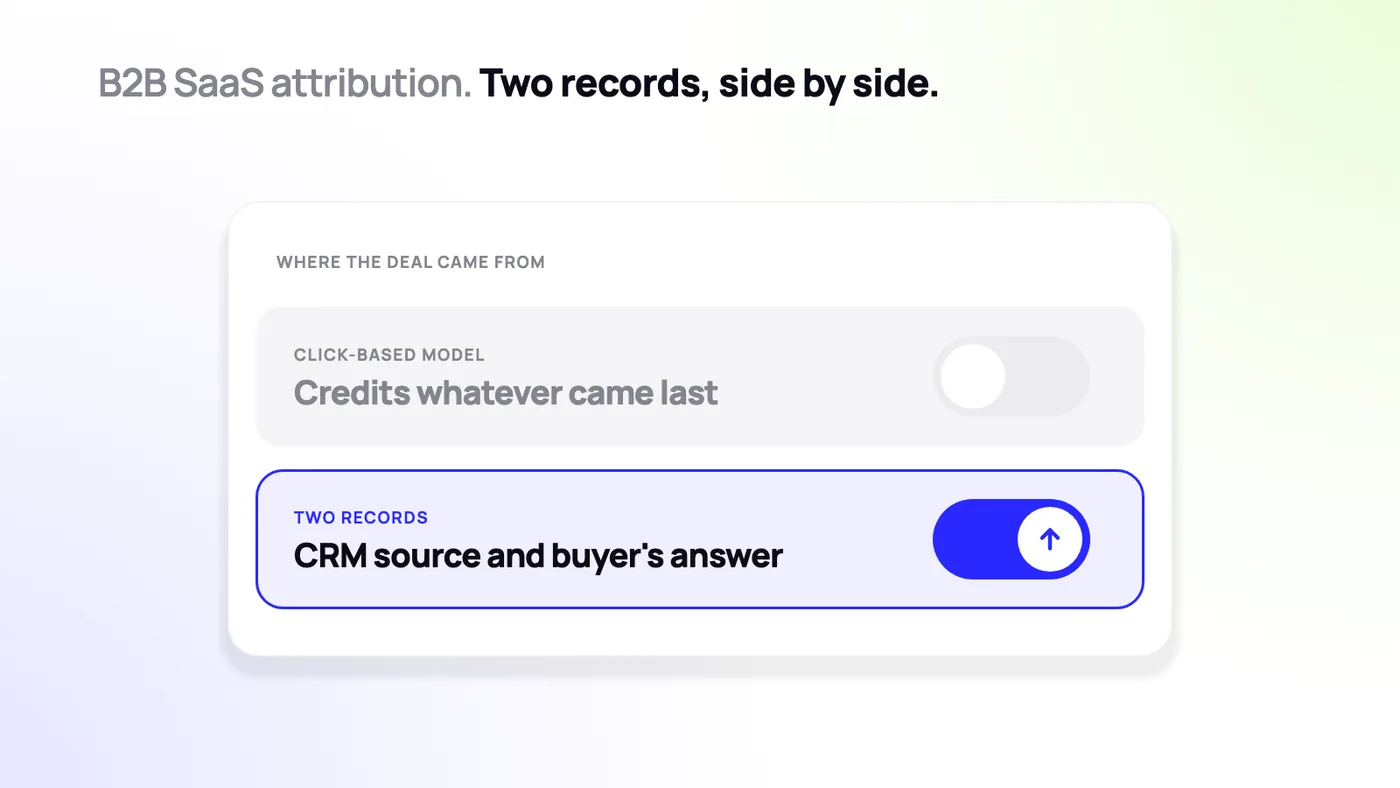
Before Series A, B2B SaaS attribution works best as two records kept side by side. One is the source your CRM captures at form fill and again when the opportunity opens. The other is the buyer's own answer to "How did you hear about us?". You compare the two every month and leave multi-touch software for later.
Why do click-based models undercount B2B SaaS deals?
B2B SaaS attribution is the practice of tying pipeline and closed revenue back to the channels and touches that produced them. A click-based model can only credit what a browser recorded. Much of what moves a B2B purchase happens away from one, in a Slack thread or on a call with a former colleague.
Three gaps cause most of the undercount.
Dark social
Dark social is sharing that happens in channels no tracker can read. When someone opens your link from a private Slack community or a WhatsApp group, it often arrives without a referrer, so analytics files the visit under direct.
A podcast mention or a tip from a former colleague leaves no trace at all. Weeks later someone types your URL, and the report logs a direct visit with no source behind it.
Several people per deal
A 2025 Gartner survey of 632 B2B buyers found buying groups of roughly five to 16 people, spread across as many as four functions. Analytics ties each touch to a browser on a device, and every one of those people brings their own laptop and phone.
Say an engineer reads your docs in March and the finance lead sees a LinkedIn post in April. When their founder books the demo in May, analytics sees three unrelated visitors and hands the deal to whatever brought the founder to the form that day.
Long cycles
A sales cycle of several months outlasts every window your tools give you. Safari counts its cookie cap in days, and GA4's default lookback for most key events is 90 days. If the first touch falls outside those windows, the model credits whatever came last.
On the budget sheet, the channel with the cleanest click trail collects the credit, and that's often paid search on your own brand name. Branded search mostly catches people who already know you and are looking for your pricing page or demo form.
The channels that created the demand look idle on the same report. Cut them on that evidence and the damage can take a quarter to show up, so we never cut a channel on last-click numbers alone.
If your CRM can't say where last quarter's deals came from, tell us where growth stands and we'll start with the source fields on those deals.
What do Safari and Chrome still let you track?
Safari's Intelligent Tracking Prevention (ITP) deletes every cookie your JavaScript creates after 7 days without user interaction with the site, according to WebKit's tracking prevention documentation. The same rule covers all other script-writeable storage, so moving the value into local storage won't save it.
Some visits get a much shorter cap, and they involve what WebKit calls link decoration: a click ID or another tracking value added to the landing page URL.
Cookies set in JavaScript on that landing page expire after 24 hours when two conditions hold. The visitor came from a domain ITP classifies as having cross-site tracking capabilities, and the landing URL carries a query string or fragment.
WebKit's ITP 2.2 announcement sets out both conditions, and the current documentation still states the 24-hour cap.
Chrome's position rests on two Google announcements. In April 2025 Google said it would keep offering users a choice about third-party cookies and wouldn't roll out a new standalone prompt, according to Google's Privacy Sandbox update from April 2025. The same update notes that Incognito mode already blocks third-party cookies by default.
Six months later, Google's October 2025 Privacy Sandbox update retired the Attribution Reporting API and several other Privacy Sandbox technologies, citing low adoption. That leaves you without the browser-level attribution API Google had built for this exact job.
| Browser rule | Source | What it does to attribution |
|---|---|---|
| Safari, cookies set in JavaScript | WebKit | Deleted after 7 days without interaction |
| Safari, visit from a tracker's decorated link | WebKit | Script-set cookies on the landing page capped at 24 hours |
| Chrome, third-party cookies | Google, April 2025 | User choice kept, no new prompt, blocked by default in Incognito |
| Chrome, Attribution Reporting API | Google, October 2025 | Retired |
None of this stops your site from reading the first visit. The UTM parameters arrive on the landing URL, and your own script can hold them until the visit ends.
The job is to write the source into the form submission while the visitor is still on the page, then store it in the CRM. A field on a contact record has no expiry date for any browser to enforce.
What does GA4 attribution give you now?
GA4 now offers three attribution models, and four others have been gone since November 2023, according to Google's GA4 attribution documentation. Advice on picking the right rule-based model is out of date, at least inside GA4.
Data-driven attribution uses machine learning to weigh both converting and non-converting paths, and Google builds a separate model for each advertiser and each key event. A key event is GA4's name for an action you mark as important, such as a demo request.
For B2B, one rule in the same documentation matters more than the model you pick. All of GA4's models exclude direct visits from credit unless the whole path to the key event is direct. When a buyer hears about you on a podcast and types your URL, that rule hands the credit to the next tracked click, which is often a branded search.
The key event lookback window defaults to 90 days for key events other than acquisition events, per Google's lookback window documentation. You can set it to 30 or 60 days instead. How many of your deals closed inside 90 days of the first visit?
GA4 also keeps user-scoped and session-scoped traffic dimensions on paid and organic last click whatever model you select, as Google's documentation on attribution and dimensions explains. So flipping the attribution setting changes less of the standard reporting than you'd expect.
GA4 sees sessions on one property up to the key event. It never sees the opportunity, the deal value or the rest of the buying group. We use it to read on-site behavior and compare campaigns inside its window, and we answer the revenue question in the CRM.
What should a seed-stage B2B SaaS track, and where?
Four records cover attribution at seed stage, and three of them live in the CRM. Each gets set at a fixed moment by a named owner, so nobody has to guess later who changed what.
| Record | Where it lives | When it's set | Who owns it |
|---|---|---|---|
| UTM convention | A shared document | Before launch | Marketing |
| Contact source fields | CRM contact | Form submission | Marketing |
| Opportunity source field | CRM deal | Opportunity creation | Sales, then locked |
| Self-reported answer | CRM contact and deal | Form submission | Buyer, grouped by marketing |
UTM rules
UTM parameters are tags on a link's URL that tell analytics where a visit came from. Google's URL builder guidance says every tagged URL should carry utm_source, utm_medium and utm_campaign.
We'd write that list before the next campaign goes out. Cleaning up mixed-case values after the fact is slow, dull work.
Source fields on the contact, at form fill
HubSpot's Original Traffic Source property records the first known web source of a contact, according to HubSpot's knowledge base on traffic source properties. HubSpot also warns that an ad-blocker can block its tracking cookies and affect those values.
That's reason enough to capture the source a second way. HubSpot's documentation on hidden form fields shows how a form can store URL parameters such as UTM values in contact properties on submission. A short script holds the landing URL and its UTMs for the visit, so the contact keeps its first-touch values even if the visitor read four pages before converting.
Source fields on the deal, at opportunity
The same HubSpot page says deals mirror the traffic source properties of their associated contacts. Put three stakeholders on a deal and the mirrored value depends on which contact the CRM happens to read.
So we add a separate opportunity source field. Sales fills it when the opportunity is created, and nobody edits it afterwards. Who on your team would notice if that value changed after the deal closed?
The self-reported field
Self-reported attribution is the buyer's own account of where they heard about you, collected in their words. Put "How did you hear about us?" on the demo or signup form as a required, open-text question.
We keep it open text. A dropdown hands the buyer a list and the easiest option wins, so the podcast episode you most need to hear about disappears into "Social media".
How we set this up when we take the seat
Taking the seat and starting the work is usually 1 to 2 weeks, and attribution is the first thing we fix. We audit before we build anything. We pull the last few months of opportunities, check each against the source the CRM recorded and mark where capture broke.
Then we write the UTM convention and add the hidden fields and the self-reported question. The locked opportunity source goes in last, once sales agrees when it gets filled and who fills it on a deal with several contacts. You can read the full sequence under how we work.
We work in monthly partnerships with a short initial commitment, and if the numbers don't show a clean path to profit, we say so upfront.
Request a slot and we'll start with the attribution audit.
How do you reconcile self-reported and tracked attribution?
A monthly reconciliation is one table that puts every opportunity opened that month beside two columns, the tracked source and the buyer's own answer. At seed stage it's the only attribution report that deserves a standing slot in your month.
| Tracked source | Buyer says | What it usually means |
|---|---|---|
| Direct or branded search | A podcast, a peer or a community | Demand created off the click trail, collected by the tracked channel |
| Paid search or paid social | The same channel | Both records agree, so the channel is doing the work |
| Paid search | "I've followed you for a while" | Paid converted demand that already existed |
| Missing | Anything | Capture is broken, so fix the form first |
Our budget rule moves money toward channels both records support. A channel that only one record supports gets a fixed test budget and a review date at the end of the quarter. It gets more money only once the other record starts to agree.
This is the table you bring to the budget meeting. Without attribution every budget call is a guess. That is the first thing we fix.
Self-reported answers come from memory, so they lean toward the last touch the buyer remembers and away from the first article they read on your site three months earlier. That bias is why the tracked record stays in the table beside them.
What can you ignore until Series A?
Google's Meridian data guidance asks for at least two years of weekly data for a geo-level marketing mix model and three years for a national one. Most attribution tooling needs volume and history a seed company doesn't have yet, so most of it can wait until after the round.
| What to ignore | Why it can wait |
|---|---|
| Multi-touch attribution software | At seed volume there are too few closed deals for any split of credit to hold steady, and the software still can't see dark social |
| Debates about rule-based models | GA4 dropped first click, linear, time decay and position-based in November 2023 |
| Marketing mix modeling | Few teams before Series A have run steady spend across several channels for two years |
| Platform-reported conversions as the record | Each platform counts what its own tracking saw, so the totals can add up to more deals than you closed |
| View-through conversions | They credit an ad that was shown and never clicked, which makes them easy to inflate and hard to check |
| Per-touch dashboards | If nobody opens one on budget day, it cost setup time and changed nothing |
Multi-touch attribution in B2B splits credit for a deal across every tracked touch, and it gets useful once enough deals close each quarter for the split to settle. At seed stage it's the purchase we'd put off longest. Buy it after the round, when there's budget for the tool and enough deals to feed it.
Revisit the list when deal volume and spend have grown past what the monthly table can hold, or when the board asks for channel-level CAC the table can't support. Until then, we own the number and the next move. No vanity metrics.
What to do next
If you can't name the source of your last ten opportunities from the CRM alone, fix capture before you move any budget.
Write the UTM convention first, then add the hidden source fields and the open-text "How did you hear about us?" question to the demo form. Lock the opportunity source in the CRM. Run the first reconciliation at the end of the month, and let the second one decide where the money goes.
Take the three-question diagnosis to see which of these records your setup is missing, or tell us where growth stands and request a slot.
Written byLuka
Want this applied to your pipeline?
No obligation. Start the conversation.