Fractional CMO cost and when it beats a full-time VP hire
Fractional CMO cost, explained. How retainers are priced, what a full-time VP of Marketing costs with benefits and equity, and when each one wins.

LukaGrowth15 min read
Key takeaways
5 things to take awayFractional CMO cost is usually a monthly retainer for a set number of days a week, so compare quotes on days and scope.
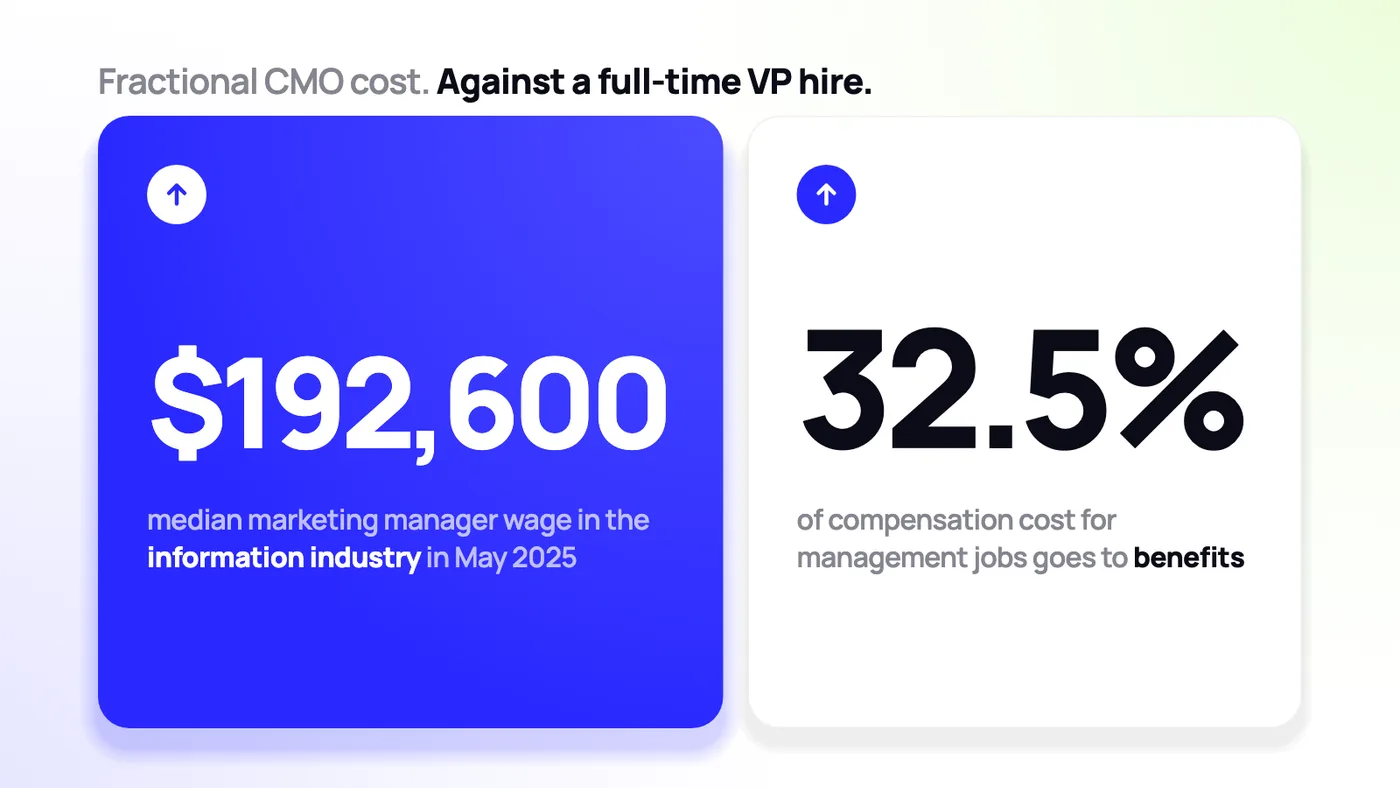
BLS puts the median marketing manager wage at $166,790 for May 2025, and at $192,600 in the information industry, which includes software publishers.
Benefits are 32.5 percent of employer compensation cost for management, business and financial jobs, so salary is about two thirds of the seat's cost.
A full-time VP also takes equity, and Index Ventures' guideline for a VP grant is 0.3 to 0.8 percent of fully diluted equity at Series A.
An agency delivers tasks against a brief, while a fractional leader owns the plan and the pipeline number until a full-time hire takes over.
The median marketing manager in the information industry, which includes software publishers, earned $192,600 in May 2025. For management jobs, that salary is only about two thirds of what the seat costs the employer.
A fractional CMO is a part-time senior marketing leader who owns your strategy and pipeline number for a share of the week, paid as a monthly retainer. It is usually the cheaper seat until the team under it needs someone there every day, and at that point the full-time VP of Marketing is the better buy.
The verdict, by situation
- Choose a fractional CMO or head of growth if you need senior judgment and one person accountable for pipeline, with a team small enough to direct in a few days a week.
- Choose a full-time VP of Marketing if several marketers already need daily management and your board expects a permanent owner of the plan.
- Choose an agency if someone in-house owns the plan and you need extra people to run a defined channel.
| Fractional CMO or head of growth | Full-time VP of Marketing | Agency | |
|---|---|---|---|
| How it's priced | Monthly retainer for set days a week, hourly for advisory, a fixed fee for audits | Salary plus benefits, payroll tax and an equity grant | Retainer or project fee per channel or deliverable |
| Paid on top | Ad spend and tools | Benefits, employer FICA, equity, search fees if you use a recruiter | Ad spend, plus someone in-house to brief and review the work |
| Time to start | Set by the provider (ours: usually 1 to 2 weeks) | The search, the offer, the notice period, then ramp | Set by the agency's onboarding |
| Owns strategy and the number | The fractional leader | The VP | You do, and the agency owns its deliverables |
| Manages the team and vendors | The fractional leader, within the agreed days | The VP, every day | Nobody, unless you add a leader |
| Commitment | Set by the contract | Employment plus an equity grant | Set by the agency's contract |
| Best fit, in our view | Seed to Series B, before a team of several marketers | Series B and later, or once the team needs daily management | Any stage with an in-house owner of the plan |
What does a fractional CMO cost?
Fractional CMO cost comes down to the days a week you buy and how much of execution the leader owns, priced as a monthly retainer.
Fractional engagements come in three pricing structures:
- A monthly retainer for a set share of the week, for example one or two days, which fits a leader who owns the plan.
- Hourly or per-session fees, which fit advisory work where you keep the decisions and the accountability.
- A fixed fee for an audit or a defined project, such as rebuilding attribution before a fundraise.
The retainer is the structure to compare against a full-time hire, since it is the only one where somebody answers for the number. Inside it, four things move the price:
- Days per week, which is the largest lever and the easiest one to change later.
- Scope, meaning strategy and direction only, or strategy plus hands-on work such as running paid search.
- Team and vendors, meaning whether the leader manages your marketers and your agencies.
- Complexity, from one product in one market to several segments with a board deck every month.
Ad spend, software and freelancers usually sit outside the retainer, so ask about them and add them to both sides of the comparison.
Ask each candidate to write the quote as days per week, the decisions they own and the metric they report on. A monthly figure without those details can't be compared with anything, including the cost of a full-time hire.
Not sure how much of the seat you need yet? Take the three-question diagnosis and see where growth stands before you collect quotes.
What does a full-time VP of Marketing really cost?
The median US marketing manager earned $166,790 in May 2025, and you pay benefits and payroll tax on top of that before equity.
BLS doesn't publish a separate wage line for VPs of Marketing, so its Occupational Outlook Handbook figures for marketing managers are the closest neutral benchmark. In the information industry, which includes software publishers, the median was $192,600. The top 10 percent of marketing managers across all industries earned more than $293,610.
We'd budget a VP of Marketing at a funded SaaS company nearer the top of that range than the median, since the role carries the plan, the team and the board conversation.
Benefits come next. BLS employer cost data for June 2026 puts benefits at 32.5 percent of total compensation cost for management, business and financial jobs in private industry, which means salary is 67.5 percent of what you pay. Put another way, benefits add about 48 cents to every dollar of salary. If your package matches that average, a $192,600 salary becomes a seat that costs about $285,000 a year.
Part of that is fixed by law. Employers pay 6.2 percent Social Security tax and 1.45 percent Medicare tax on wages, and the Social Security part stops at $184,500 of wages in 2026.
Equity is the cost that is easiest to leave out of the spreadsheet. Index Ventures' published guideline puts a VP-level grant at 0.3 to 0.8 percent of fully diluted equity at Series A, and 0.2 to 0.7 percent at Series B, with product and engineering hires at the high end. Say your company is valued at a hypothetical $50 million after the round. Half a percent of that is $250,000 of equity, granted to one hire.
Then there is the time the seat stays empty. A search runs from the brief to a signed offer and a notice period, and pipeline decisions fall back on the founder until someone starts. After that, a new VP spends the first stretch learning the product and the buyers before changing the plan.
| Cost component | What it adds |
|---|---|
| Base salary | $166,790 median for marketing managers, $192,600 in the information industry (BLS, May 2025) |
| Benefits and payroll tax | 32.5 percent of total compensation cost for management, business and financial jobs (BLS, June 2026) |
| Employer FICA | 6.2 percent Social Security up to $184,500 of wages, plus 1.45 percent Medicare (IRS, 2026) |
| Equity | 0.3 to 0.8 percent at Series A, 0.2 to 0.7 percent at Series B (Index Ventures guideline) |
| Search and ramp | Weeks with the seat empty, then weeks while the hire learns the business |
Fractional CMO vs full-time CMO, which seat costs less?
A fractional retainer buys a share of a senior leader's week, while a full-time hire buys the whole week plus benefits and an equity grant.
The fair comparison is cost per day of senior time. Divide the full cost of the full-time seat by the 260 weekdays in a year, and divide the retainer by the days it covers each month. At about $285,000 a year, the full-time seat costs roughly $1,100 per weekday before equity, and you can set any fractional quote against that figure.
Per-day cost is only half the decision. A full-time VP is in the room when a deal stalls on a Tuesday. Over a year, that person also builds the team's habits and keeps what the company learns inside the company. A fractional leader brings judgment from other companies and needs no equity, and you can scale the days down when the work shrinks.
Which of those matters more to you this year?
The fractional math holds only while the leader stays a contractor, and the IRS looks at the entire relationship and how far you control the way the work is done. It weighs behavioral control, financial control and the type of relationship. Buy a result with a written scope, since a part-time job with set hours, your laptop and your process reads more like employment.
Which is better for a seed-stage company?
At seed, a fractional leader is usually the better buy, since the seat sets positioning and the first channel more than it manages people.
At this stage the seat must own four things:
- Positioning, meaning who you sell to and why they would switch from what they use now.
- The first repeatable channel, tested with a budget you can afford to lose.
- Attribution, so the next budget call rests on data you trust.
- The plan for the first marketing hire, written before you post the role.
Without attribution every budget call is a guess. That is the first thing we fix.
You need the seat now if pipeline is founder-led, meaning it comes from the founder's own network and calls. The same goes if pipeline is paid-dependent and drops the week spend pauses, or if it has been flat for two quarters while the team stays busy.
Who decides next quarter's channel budget today, and what is that decision based on?
Skip the fractional seat if there is no budget and nobody to execute. A senior leader with nobody to execute writes a plan that never runs, and at that point a single strong hire or a specialist for one channel does more for the money.
Which is better at Series A and Series B?
At Series A, fractional still fits when the team is small, and by Series B several marketers need a full-time leader every day.
The seat owns more at this stage. It sets the channel mix across paid, organic and outbound, and it reports CAC and payback to the board. Building the funnel and hiring the in-house team sit with it too.
The funnel matters as much as the channels. Paid works while you pay. Without a funnel behind it, CAC only goes one way.
Fractional still wins at Series A in two cases. The first is a bridge: the fractional leader runs the seat, writes the VP role and joins the interviews, so the full-time hire arrives to a working system. The second is a team that executes well and needs senior direction a few days a week.
Full-time wins once several people report into the seat and decisions can't wait for the next working day. It also wins when the board wants one permanent owner of the plan through the next raise, and when the job is building a department that will outlast any one campaign.
How we take the growth seat
We take the growth seat the way a senior in-house leader would, for teams with traction that aren't ready to hire a full-time VP. We audit first, and attribution is the first thing we fix. Then we set the strategy and the system and own execution across paid media, the funnel and the tooling. We report on the number, so you can decide the next move with data you trust.
The team has scaled a company to €40M ARR. Our Native Teams case study follows an EOR platform from no revenue and no marketing function to operating in 95 countries. We work in monthly partnerships with a short initial commitment, and taking the seat takes usually 1 to 2 weeks.
See how we work, from the first audit and the attribution fix to the report and the next decision.
Fractional CMO vs marketing agency, who owns the number?
An agency delivers tasks against your brief, while a fractional leader writes the brief, picks the channels and answers for pipeline.
That difference decides who carries the risk. With an agency, someone in your company still has to set the targets, read the reports critically and decide when a channel has had enough budget. If nobody senior does that, the reports drift toward activity such as impressions and clicks, and the link to revenue goes unexamined.
An agency is the right buy when the plan exists and is owned in-house. A defined job, such as running paid social against a target CAC, is what agencies are set up to deliver.
The two also combine. A fractional leader can direct your agencies, set their targets and judge their work against pipeline, which is where a retainer can pay back first.
We own the number and the next move. No vanity metrics. What the growth seat covers lists the five lines we run as one system.
Who should switch from fractional to full-time?
Switch to a full-time VP once the team needs daily management, the board expects a permanent owner and the fractional days keep growing.
These are the signals we'd watch for:
A good handover is part of the fractional job. The fractional leader writes the role, joins the interviews and leaves a system that keeps running, with us or the first in-house hire.
Fractional also isn't for every company. A team before product-market fit with no budget to execute gets a plan and no one to run it, and a company that only needs one channel run is better served by a specialist or an agency.
Frequently asked questions
1. What is a fractional CMO's hourly rate?
A retainer for set days fits a leader who owns the plan, and hourly billing fits advisory calls where you keep the decisions. To compare a retainer with an hourly quote, divide the monthly fee by the hours it covers. A low hourly figure on an advisory contract buys answers, while a retainer buys decisions and someone accountable for them.
2. How many days a week does a fractional CMO work?
The days follow the scope. A seed company fixing positioning and attribution needs fewer days than a Series B team with several marketers and a monthly board deck. Agree the days in writing, and review them each quarter as the work changes.
3. What is the difference between a fractional head of growth and a fractional CMO?
The titles overlap. A fractional CMO title suggests brand, positioning and the whole marketing function, and a fractional head of growth title suggests pipeline, channels and conversion. At a seed to Series B B2B SaaS company one person often holds both, so read the scope in the contract before the title on the proposal.
4. How long does a fractional CMO engagement usually last?
Length depends on the contract and on when a full-time hire takes over. Ours are monthly partnerships with a short initial commitment, with no year-long lock-in, and if the numbers don't show a clean path to profit, we say so upfront. Give any engagement one full reporting cycle against a clear metric before you judge it.
5. Do fractional CMOs get equity?
That is your call. If you grant equity to a fractional leader on a contract, it can't take the form of incentive stock options, since the tax code reserves those for employees. Your counsel would set up another kind of grant. A cash retainer leaves the cap table untouched, which is one of the cost advantages over a full-time VP.
6. Can a fractional CMO hire and manage a marketing team?
Yes, within the days the contract covers. A fractional leader can define roles, run interviews and manage a small team and its agencies. Once daily management fills most of the week, the seat has outgrown the fractional model, and that is the point to hire the full-time VP.
What to do next
Start from what the seat must own over the next two quarters. If that is positioning, the first channel and attribution, a fractional leader covers it for a share of the week. Budget a full-time VP at the full cost, with about 48 cents of benefits on every salary dollar and an equity grant on top. Choose an agency when someone in-house already owns the plan.
Tell us where growth stands through the form on our homepage, or email hello@frctnl.agency, and we'll say whether the seat needs a fractional leader, a full-time hire or neither yet.
Written byLuka
Want this applied to your pipeline?
No obligation. Start the conversation.