Why OpenAI Moved Now
OpenAI didn't launch ads in ChatGPT to make a little extra money on the side. It launched them because subscription revenue alone doesn't fund the capex a frontier model company needs to stay ahead, and because every consumer platform that has reached ChatGPT's scale eventually monetizes through advertising.
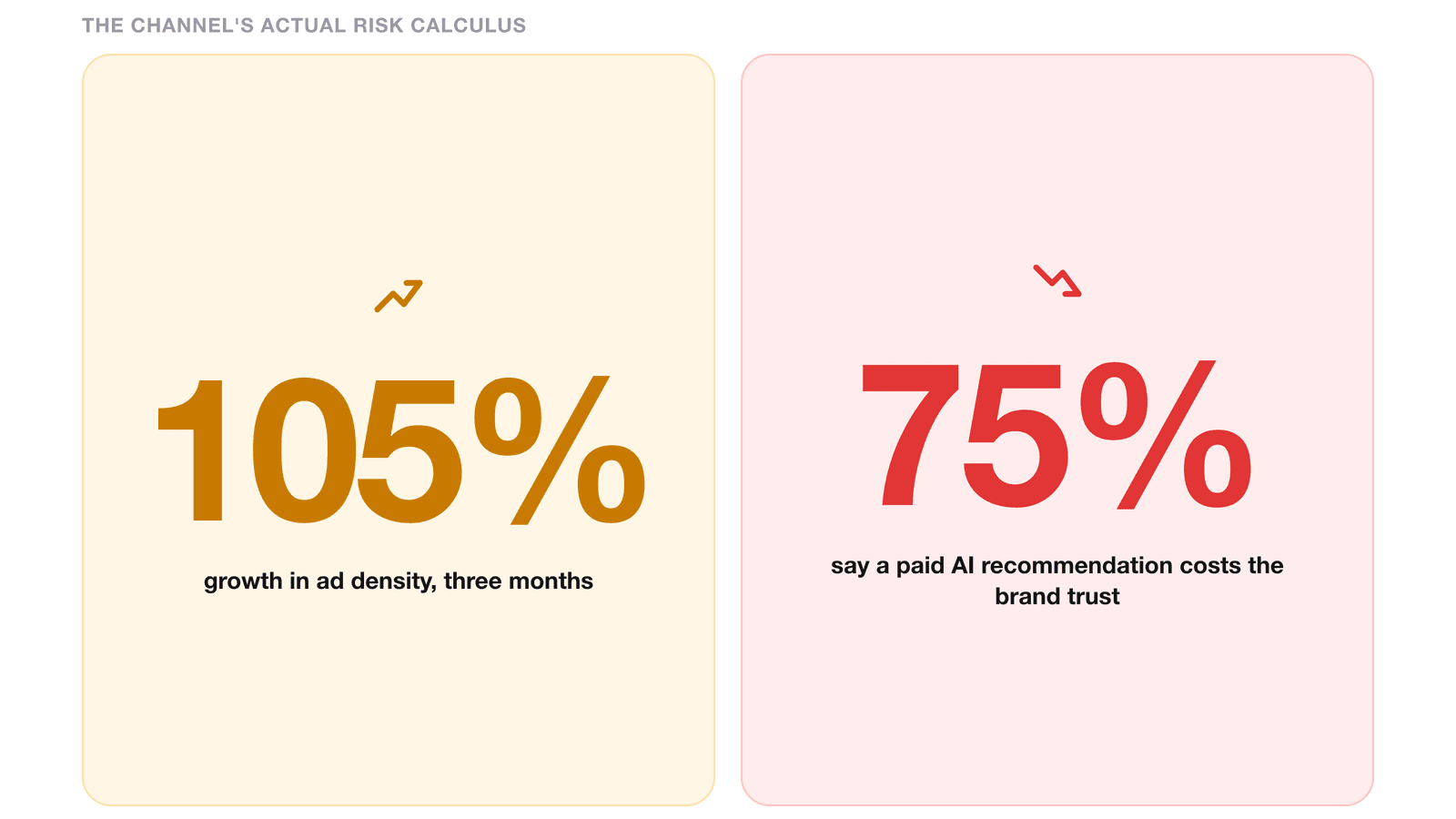
What's different is the pace: ad density climbed 105% between April and July 2026, and the advertiser pool nearly tripled from 298 to 820 in the same window (Yahoo Finance). Dropping the $50,000 minimum spend in May and opening self-serve access to SMBs, startups, and the big agency holding companies all at once is the land-grab move you make when you want scale before you want polish.
For a SaaS founder or growth operator, the ad format itself isn't the interesting part. Right now it's a favicon and a line of text, CPC only, with no third-party measurement and no CPA bidding despite both being publicly promised (Digiday). The interesting part is the sequencing.
OpenAI is building the advertiser base first and the trust infrastructure second, the opposite of how Google and Meta built their ad businesses, where measurement and brand-safety tooling largely preceded mass advertiser adoption. It's a bet that demand for placement inside the highest-intent surface in software will outrun the usual due-diligence cycle.
The Uncomfortable Number
The counterweight is a genuinely uncomfortable data point. In a Quad/Harris Poll survey of 2,180 US adults conducted in February 2026, 75% said they'd lose confidence in an AI shopping agent, and trust the brand less, if they found out its recommendations were paid for (Quad/Harris Poll).
That's not a hypothetical risk for OpenAI, it's the exact dynamic it's now monetizing into. Early advertisers already testing the surface include Target, Williams-Sonoma, Albertsons, and The Knot Worldwide directly, plus Adobe, Audible, Ford, and Mazda through Omnicom's agency access (Floodlight), so this isn't a fringe experiment, it's already attracting brands with real budgets and real brand-safety teams.
Omnicom in particular used its holding-company scale to secure placement access for more than 30 client brands during the invite-only pilot phase, which required a $200,000 minimum commitment before the May opening, a deliberate first-mover play to absorb early-stage risk in exchange for a data and relationship head start.
The strategic read: the acquisition-channel calculus here is closer to buying Facebook ads in 2007 than buying Google Search ads in 2024. No attribution you can trust yet, a real risk the format erodes the exact trust that makes ChatGPT a high-intent surface in the first place, but also genuinely underpriced attention relative to where it'll be once measurement catches up and CPMs adjust.
So What Do You Actually Do
The honest takeaway isn't "go all in" or "ignore it." It's that this is a small-bet, high-optionality category. Worth a controlled test with money you can afford to learn from, tracked with your own UTM and conversion discipline since OpenAI's tracking isn't there yet, and worth revisiting hard the moment CPA bidding and third-party measurement actually ship.
If a channel offers genuinely underpriced attention but zero reliable attribution, the honest question every operator should be asking isn't whether to test it, it's at what dollar amount "worth testing" turns into "irresponsible with the board's money."